Smoking Salmon at Home Without Special Equipment
You do not need a dedicated smoker. A regular grill, some wood chips, and this technique will produce smoked salmon that beats anything from the store.
The setup
You need a grill with a lid. Gas or charcoal, either works. A dedicated smoker is nice but not necessary. The key is indirect heat and a way to produce smoke — a foil pouch of wood chips handles the second part.
Wrap a handful of soaked wood chips in aluminum foil, poke a few holes in the top, and place the pouch directly on the heat source. Close the lid. That is your smoker. The whole setup costs nothing beyond what you already own.
My first attempt at smoking salmon was indoors with a stovetop smoker. It set off every smoke detector in the house and my neighbor came over to check if something was on fire. The salmon was actually good, but I smoke outdoors now.
The brine
Salmon gets brined before smoking. The brine seasons the fish and draws out excess moisture so the smoke adheres to the surface instead of sliding off.
Salmon brine ratio: 1/4 cup kosher salt and 1/4 cup brown sugar per 4 cups of water. The sugar balances the salt and helps the exterior develop a glossy, caramelized finish called the pellicle.
Brine the salmon for 4-8 hours in the fridge. Four hours is the minimum for a 1-inch fillet. Past 8 hours, the texture starts to get overly firm and the salt level pushes into aggressive territory. After brining, rinse the fillets under cold water and pat dry. Then place them on a wire rack in the fridge, uncovered, for 1-2 hours. This drying step forms the pellicle — a tacky surface that grabs smoke.
Choosing your salmon
Wild-caught frozen salmon at $10-$14 per pound is a better starting point than the "fresh" salmon at the fish counter, which was almost certainly frozen on the boat and thawed for display. Buying frozen means you control when the clock starts. Thaw it in the fridge overnight and you have fish that is as fresh as anything in the case — often fresher, at $4-$6 less per pound.
Farmed Atlantic salmon ($8-$10/lb) also works. It has more fat, which keeps the fish moist during smoking. For a first attempt, fattier is more forgiving.
Either way, look for fillets that are 1 inch thick at the thickest point and relatively uniform. Uneven fillets mean the thin tail end overcooks while the thick center is still raw. If you can only find a whole side, cut it into portions of similar thickness before brining.
The smoking process
- Set up indirect heat. For a gas grill: light one burner on low and place the salmon on the unlit side. For charcoal: push the coals to one side and put the fish on the other. Target grill temperature: 225°F / 107°C.
- Add the smoke pouch. Place the foil pouch of wood chips directly on the lit burner or on the coals. Close the lid.
- Smoke for 45-60 minutes. A 1-inch fillet at 225°F takes 45-60 minutes. Do not open the lid more than once or twice — every opening drops the temperature and extends the cook time.
- Check for doneness. The salmon is done when the internal temperature reaches your target (see below) and the surface has turned a deep golden-amber color. A white protein (albumin) will appear on the surface. That is normal.
Wood chips: what to use
- Alder: The traditional choice for salmon. Light, sweet smoke that does not overpower the fish. This is the safe pick.
- Apple: Slightly sweeter than alder. Good if you are using a maple or brown sugar glaze.
- Cherry: Adds a mild fruity note and gives the surface a darker color.
- Hickory: Strong and assertive. Use sparingly with fish — a full batch of hickory chips can make salmon taste like bacon, which is not the goal.
Soak the chips in water for 30 minutes before wrapping them in foil. Soaking slows the burn so the chips smolder and smoke instead of catching fire and producing harsh, acrid flavors.
How to tell when it is done
The USDA says 145°F / 63°C. That produces fully cooked, firm salmon. It is safe but not what most people prefer for texture.
For a texture closer to restaurant-quality smoked salmon — moist, slightly translucent in the center — pull it at 125°F / 52°C. The carryover heat from the thick fillet will push it up another 5 degrees as it rests. At this temperature the fish flakes easily but still has some give. An instant-read thermometer is the only reliable way to hit this window.
After removing the salmon from the grill, let it rest for 5 minutes before serving. It holds well at room temperature for 20-30 minutes, which makes it practical for a dinner where not everything finishes at the same time.
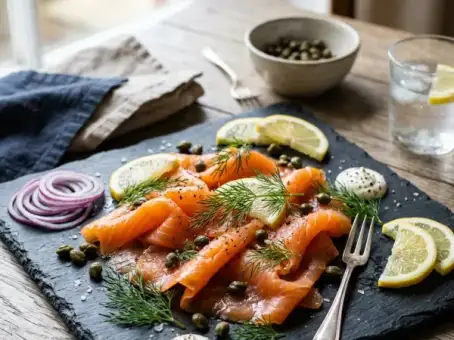
For the full recipe with a maple-soy glaze, see the smoked salmon recipe. If you want a quicker weeknight salmon option that skips the smoking entirely, the salmon rice bowls come together in under 30 minutes. And the same brining principle applies to chicken — the chicken brine guide covers the technique in more detail.
Gear that helps
- Weber Smokey Mountain 18-inch — $350-$400. Holds temp steady for hours without babysitting.
- Alder or apple wood chips — $8-$12. Mild smoke that does not overpower fish.
- Instant-read thermometer — $10-$15. Pull at 125°F for the best texture.
Frequently Asked Questions
Can I smoke salmon in a regular oven?
Not effectively. Ovens do not produce smoke. You can bake salmon at a low temperature for a similar texture, but the smoke flavor will be absent. Liquid smoke added to the brine is a workaround, but it does not compare to actual wood smoke.
How long does smoked salmon last in the fridge?
3-5 days in an airtight container. It also freezes well for up to 2 months. Vacuum-sealed portions thaw in the fridge overnight and taste nearly as good as fresh.
What is the white stuff on my smoked salmon?
Albumin — a protein that gets pushed to the surface as the fish cooks. It is harmless and normal. Brining and smoking at a lower temperature reduces it but does not eliminate it entirely. Scrape it off if it bothers you.
Do I need to flip the salmon during smoking?
No. Smoke at indirect heat with the skin side down the entire time. The skin acts as a barrier between the fish and the grate, preventing sticking and protecting the bottom from direct heat.
Can I use a pellet grill?
Yes, and it makes temperature control easier. Set it to 225°F and let the pellet grill manage the airflow. The smoke production is consistent and hands-off. It is the simplest way to smoke salmon, but it also costs $300+ for the grill. The foil pouch method on a regular grill costs nothing.