Old Fashioned Salmon Patties Recipe (Crispy Pan-Fried)
Salmon patties made with canned salmon, bound with egg and breadcrumbs, pan-fried in 4 minutes per side. No fancy ingredients. The method your grandmother used works because it has always worked.
Why canned salmon works
An old fashioned salmon patties recipe starts with a can of salmon, not a fresh fillet. That is not a compromise. It is the correct choice for this dish. Canned salmon is already cooked, flakes apart with a fork, and binds easily with egg and breadcrumbs. Fresh salmon requires cooking first, which adds time and a step that does not improve the final product.
Most "fresh" salmon at the supermarket was frozen on the boat, thawed for display, and is now sitting on ice losing quality by the hour. Buying a can of wild-caught salmon at $3-$5 per can frequently outperforms the $16-$20/lb "fresh" salmon sitting behind the fish counter glass. The price difference is $4-$6/lb with equal or better quality for a recipe where the fish gets mixed with binders and pan-fried anyway. Save the premium fillet for a dish where the salmon is the solo act.
Use a 14.75 oz can of salmon (the standard size). Pink salmon or red sockeye both work. Drain the liquid, then check through the fish with a fork and remove any large bones or skin pieces. Some people leave the small bones in — they are soft, edible, and a good source of calcium. Your call.
The binding ratio that holds patties together
The reason salmon patties fall apart in the pan is almost always the same: too much moisture and not enough binder. The ratio that works is 1 large egg and 1/3 cup breadcrumbs per 14.75 oz can of salmon. This gives you patties that hold together during flipping without tasting like breaded cardboard.
Use plain dry breadcrumbs, not panko. Panko is too coarse for this — the patties will not bind properly. Dry breadcrumbs absorb the excess moisture from the salmon and create a cohesive mixture you can shape with your hands.
For seasoning, you need less than you think. I spent years buying pre-seasoned fish products from the grocery store deli section because I assumed seasoning was complicated. One day I realized that salt, pepper, and a squeeze of lemon on plain protein outperformed every pre-made option I had ever bought. For these patties: 3/4 teaspoon kosher salt, 1/4 teaspoon black pepper, 2 tablespoons finely diced onion, and 1 tablespoon of lemon juice. That is it.
Forming and chilling the patties
Combine the drained salmon, egg, breadcrumbs, onion, salt, pepper, and lemon juice in a bowl. Mix with a fork until just combined. Do not overwork it — you want some texture, not a paste.
Divide the mixture into 8 equal portions (about 2 tablespoons each). Shape each one into a patty roughly 3 inches wide and 1/2 inch thick. Press firmly enough that the patty holds its shape, but do not compact it into a hockey puck.
Place the formed patties on a sheet pan lined with parchment paper and refrigerate for 15 minutes. Chilling firms the patties so they do not crumble when they hit the hot pan. Skipping this step is the second most common reason salmon patties fall apart (after using too little binder).
Pan-frying technique
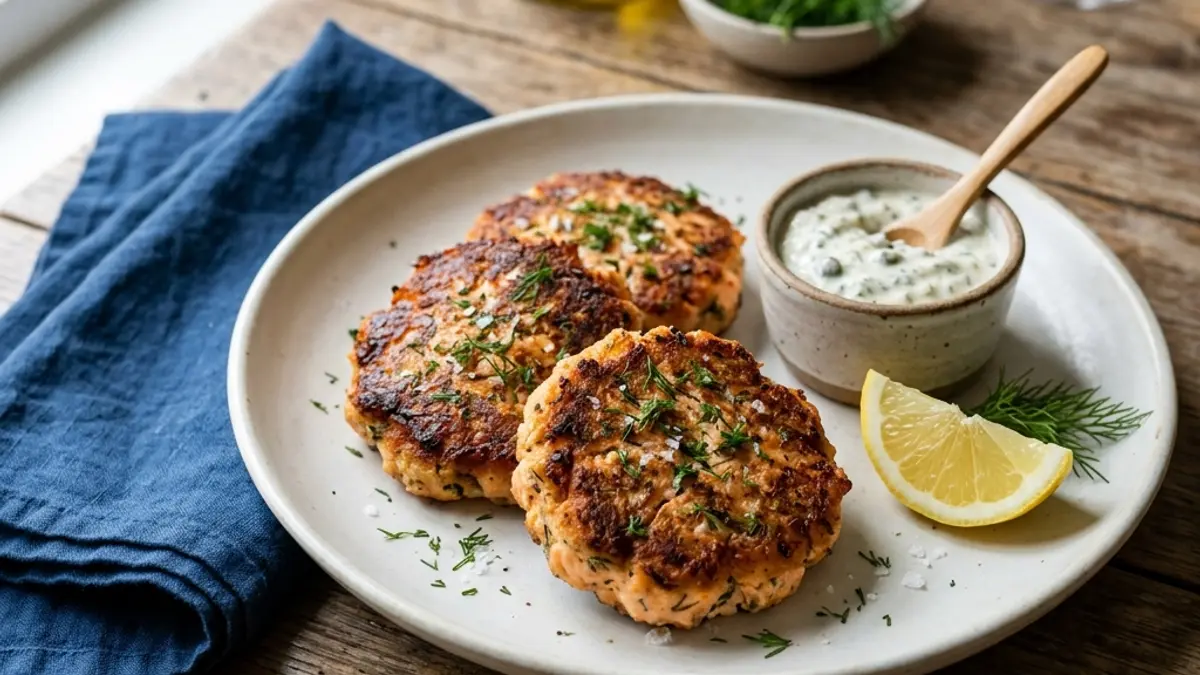
The temperature matters more than you expect. Do not use high heat. Unlike searing a steak, salmon patties need medium heat — roughly a 6 out of 10 on your burner. High heat burns the breadcrumb coating before the center warms through. Medium heat gives you a deep golden crust in 4 minutes per side with an evenly heated interior.
- Heat the oil. Add 2 tablespoons of neutral oil (vegetable or canola) to a 12-inch skillet over medium heat. Wait 2 minutes for the oil to shimmer.
- Place the patties. Gently set the chilled patties in the pan, leaving at least 1 inch of space between them. Do not crowd the pan — work in two batches if needed.
- Cook undisturbed. Let each patty cook for exactly 4 minutes without moving it. The bottom should be deep golden-brown.
- Flip carefully. Use a thin spatula to flip each patty. Cook the second side for 3-4 minutes until equally golden.
- Drain. Transfer the finished patties to a plate lined with a paper towel.
If the patties are browning too fast, lower the heat. If they are taking longer than 5 minutes per side, raise it slightly. The crust should be deep golden, not pale and not blackened.
For more on the difference between pan-frying fish at medium heat vs. searing at high heat, check the technique used in our salmon bites recipe, which uses a hotter pan for smaller pieces that cook in under 3 minutes per side.
Serving and pairing ideas
Salmon patties are a full meal with a side and a sauce. They do not need much.
- Classic: Serve on a plate with tartar sauce, a lemon wedge, and steamed rice. This is the old fashioned way. It works.
- Sandwich: Place a patty on a toasted brioche bun with lettuce, tomato, and a spread of mayo mixed with a squeeze of lemon juice.
- Over greens: Set two patties on a bed of mixed greens with a simple vinaigrette. The warm patty slightly wilts the greens underneath.
If you want a rice-based salmon meal that uses fresh fillets instead of canned, the weeknight salmon rice bowls post covers building a complete bowl from pan-seared salmon. For a completely different preparation of salmon, our guide to smoking salmon at home walks through the outdoor smoking process from brine to finish.
The USDA food and nutrition resources cover proper handling and storage of canned fish products after opening, which is worth checking if you plan to prep patties in advance.
Gear that helps
You do not need specialty equipment. A regular skillet and a spatula handle this recipe. But a few things make the process smoother.
Gear that helps
- 12-inch nonstick skillet — $25-$35. Nonstick is the right choice here. Salmon patties are delicate, and a nonstick surface lets you flip without the crust sticking to the pan.
- Thin fish spatula — $10-$15. The angled, flexible blade slides cleanly under a patty without breaking it. A thick spatula will crumble the edges.
For more on why simple, affordable tools outperform expensive alternatives, see the Serious Eats fish spatula guide — the $12 option consistently outperforms models three times its price.
For the full step-by-step recipe with exact measurements and timing, see the companion old fashioned salmon patties recipe page. If you want a different way to use canned or smoked salmon, the smoked salmon recipe starts from scratch with raw fillets and a stovetop or outdoor smoker.
Frequently Asked Questions
Can I use fresh salmon instead of canned?
You can, but you will need to cook and flake it first, which adds 15-20 minutes. Canned salmon is already cooked and produces the same result in a fraction of the time. For salmon patties specifically, the canned version is the better tool for the job.
Why do my salmon patties fall apart?
Two reasons: not enough binder (use 1 egg and 1/3 cup breadcrumbs per can) or skipping the chilling step. Refrigerating the formed patties for 15 minutes firms the mixture so it holds together in the pan.
Can I bake salmon patties instead of pan-frying?
Yes. Place them on a parchment-lined baking sheet and bake at 400°F for 10-12 minutes per side. They will not get as crispy as pan-fried, but they work well for a hands-off method.
How do I store leftover salmon patties?
Refrigerate in an airtight container for up to 3 days. Reheat in a skillet over medium heat for 2 minutes per side. The microwave works but softens the crust.