The Best Beef Cuts for Slow Cooking
Not every cut belongs in a crock pot. These are the specific cuts that break down into something tender after 6-8 hours, and the ones that will turn to mush.
The short answer
The cuts with the most connective tissue make the best slow cooker meals. Chuck roast, beef back ribs, short ribs, and brisket point all have dense networks of collagen that melt into gelatin over 6-8 hours on low. That gelatin is what makes the sauce thick and the meat tender enough to pull apart with a fork.
Lean cuts — tenderloin, sirloin, eye of round — have almost no connective tissue. In a slow cooker they do not get tender. They get dry and stringy. Spending more money on a better cut does not help here. You want the cheap, tough ones.
Why some cuts work and others fall apart
Connective tissue is mostly collagen. Below about 160°F, collagen is tough — it is the reason a braised roast at the two-hour mark still feels chewy. Above 180°F and given enough time, collagen converts to gelatin. Gelatin is soft, slippery, and holds moisture. That is the transformation you are waiting for in a slow cooker.
Lean cuts skip this process entirely because they have nothing to convert. They reach 160°F, the proteins tighten, moisture gets squeezed out, and the meat dries from the inside. No amount of liquid in the pot saves it.
The best cuts for the crock pot
Chuck roast
The workhorse. Chuck comes from the shoulder, which gets constant use on the animal. That exercise builds connective tissue. A 3-4 lb chuck roast on low for 6-8 hours shreds into something that does not taste like it cost $5-$6 per pound. It is the best value in the meat case for slow cooking.
Beef back ribs
Overlooked and underpriced. A full rack runs $15-$20 and feeds four people. The bones add flavor to the braising liquid, and the meat between and around them gets fall-off-the-bone tender at 275°F in 3.5-4 hours, or in the slow cooker on low for 6-8. The beef back ribs recipe goes into full detail.
Short ribs (bone-in)
More expensive than chuck but worth it when the budget allows. Short ribs have thick layers of fat and collagen between the meat and bone. After a long braise the fat renders, the collagen melts, and the meat practically dissolves. Bone-in holds together better than boneless in a slow cooker.
Brisket point (not flat)
The brisket has two muscles. The flat is leaner and better for slicing. The point has more fat and connective tissue — it is the part that makes good burnt ends. In a slow cooker, the point breaks down beautifully. The flat dries out. If your butcher sells whole packer briskets, ask them to separate the point for you.
Cuts to avoid
- Top round / eye of round: Lean, tight grain, very little collagen. Dries out fast.
- Tenderloin: Already tender. Slow cooking makes it mealy. This is a quick-cook cut.
- Sirloin: Fine for grilling. Not enough fat or connective tissue for 6+ hours.
- Flank steak: Thin, lean, and best served medium-rare. The slow cooker turns it to fiber.
Ground beef in the slow cooker
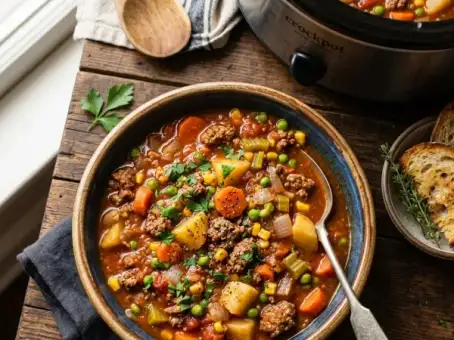
Ground beef works differently because the structure is already broken down. You are not relying on collagen conversion — you are building flavor through a long simmer with aromatics and liquid.
Brown the ground beef first. Do not dump raw ground beef into the crock pot. Browning in a skillet for 5-7 minutes creates Maillard reaction flavors that the slow cooker cannot replicate. Drain the excess fat, then transfer. Standard 80/20 ground beef at $5-$6 per pound has enough fat for flavor without making the final dish greasy after draining.
Ground beef safe internal temperature is 160°F / 71°C. In a crock pot on low, it reaches that within the first hour. The remaining time is about building depth in the sauce. See the ground beef crock pot recipes for three specific variations that use this approach.
Time and temperature
The crock pot low setting for tough cuts is 6-8 hours. High setting cuts that roughly in half but produces slightly less tender results because the collagen converts faster and less completely.
There is no advantage to going longer than 8 hours for most cuts. Past that point, the meat starts to dry out even in liquid. The connective tissue has already converted, and the muscle fibers begin to tighten and squeeze out moisture again. Six hours is usually enough for a 3 lb chuck roast. Eight is the safe upper limit.
An instant-read thermometer is useful here too. When the internal temperature of a braise hits 200-210°F and a fork slides in with no resistance, it is done. Time is a guideline. Probe tenderness is the actual test.
Gear that helps
- Crock-Pot 6-quart slow cooker — $30-$50. The workhorse for low and slow cooking.
- Lodge Dutch oven — $50-$70. Stovetop to oven in one pot, better browning than a slow cooker.
- Instant-read thermometer — $10-$15. Ground beef needs to hit 160°F, no exceptions.
Frequently Asked Questions
Should I sear the meat before slow cooking?
For whole cuts like chuck roast or short ribs, yes. Searing for 2-3 minutes per side in a hot pan builds a crust and adds flavor compounds that the slow cooker cannot create on its own. For ground beef, browning serves the same purpose.
Can I use water instead of broth?
You can, but the result will taste like it. If you do not have broth, add a tablespoon of tomato paste and a splash of soy sauce to the water. That gets you closer to a braising liquid with actual body.
Why is my slow cooker beef tough after 6 hours?
Either the cut is too lean (not enough collagen to convert) or it needs more time. If you are using chuck and it is still tough at 6 hours, give it another hour. If you are using eye of round, no amount of time will fix it — the wrong cut went in.
Do I need to flip the meat halfway through?
No. The liquid and steam circulate inside the closed crock pot. Opening the lid drops the temperature and adds 20-30 minutes to the cook time. Leave it alone.
Can I cook beef from frozen in a slow cooker?
The USDA advises against it because the meat spends too long in the danger zone (40-140°F). Thaw in the fridge overnight first.